Personal Loans: A Complete Guide to Borrowing Money in 2026
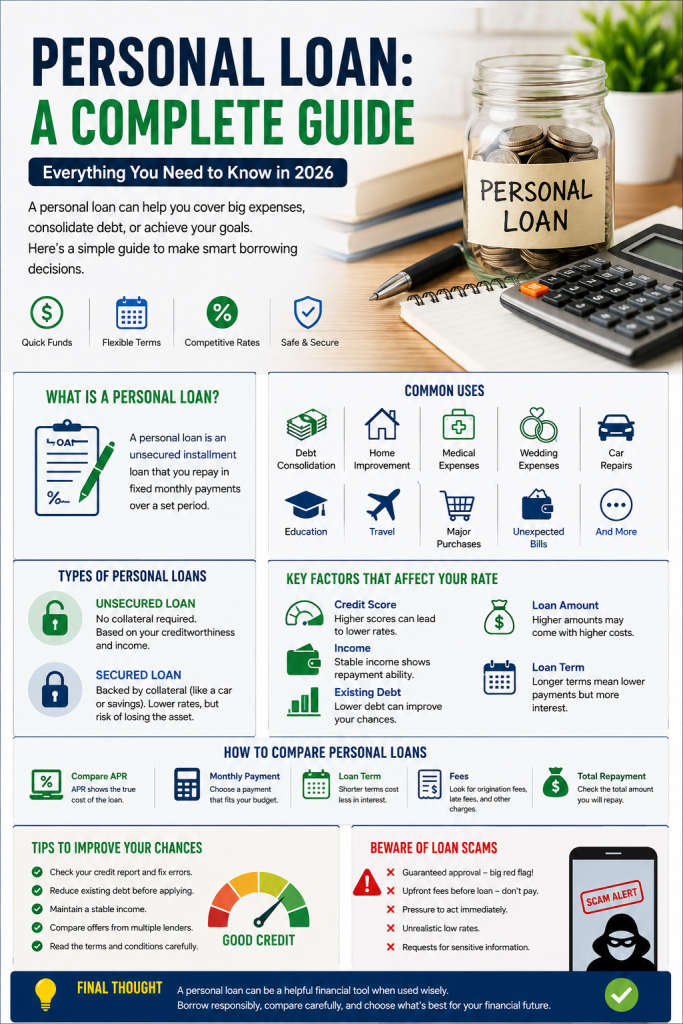
A personal loan can be a useful way to cover a major expense, consolidate debt, pay for an unexpected bill, or finance a personal project. Unlike a mortgage or auto loan, a personal loan can often be used for a variety of purposes, depending on the lender’s terms.
However, borrowing money is a financial decision that should not be taken lightly. The interest rate, Annual Percentage Rate (APR), fees, repayment period, monthly payment, and total amount you repay can all affect whether a personal loan is affordable.
This guide explains how personal loans work, what lenders look for, how to compare offers, and what to watch for before submitting an application.
Table of Contents
What Is a Personal Loan?
A personal loan is typically an installment loan in which you receive a specific amount of money upfront and repay it through scheduled payments over an agreed period.
Personal installment loans are generally closed-end loans. This means you receive the loan proceeds at the beginning and repay the balance through fixed or scheduled installments. They can be used for purposes such as large purchases, unexpected expenses, or debt consolidation.
For example, you might borrow $10,000 and repay the loan over several years. Your actual monthly payment and total cost will depend on the interest rate, fees, loan term, and lender.
How Do Personal Loans Work?
The process is usually straightforward:
- You apply for a loan with a bank, credit union, or online lender.
- The lender evaluates your application, which may include your credit history, income, existing debts, and other information.
- The lender provides an offer if you qualify.
- You review the loan terms, including the APR, fees, monthly payment, and repayment period.
- You accept the loan if the terms fit your needs.
- You receive the funds according to the lender’s process.
- You make scheduled payments until the loan is paid off.
Lenders may consider your credit reports and other financial information when determining the interest rate and terms you qualify for.
What Can You Use a Personal Loan For?
Depending on the lender, personal loans may be used for a variety of legitimate expenses, including:
- Debt consolidation
- Home improvement projects
- Medical or emergency expenses
- Major purchases
- Moving expenses
- Unexpected bills
- Wedding expenses
- Education-related expenses
- Vehicle repairs
- Other personal expenses
Always check the lender’s rules before applying because some lenders restrict certain uses.
Secured vs. Unsecured Personal Loans
Personal loans generally fall into two broad categories.
Unsecured Personal Loans
An unsecured personal loan does not require you to pledge an asset such as a car or home as collateral.
Because the lender does not have specific collateral securing the loan, approval and pricing can depend heavily on your creditworthiness and other financial factors.
Secured Personal Loans
A secured loan is backed by collateral. If the borrower fails to meet the agreement’s requirements, the lender may have rights related to that collateral, depending on the contract and applicable law.
Before choosing a secured loan, understand exactly what asset is being used as collateral and what could happen if you cannot make the payments.
Personal Loan Interest Rate vs. APR
One of the most important things to understand when comparing personal loans is the difference between the interest rate and APR.
The interest rate represents the cost of borrowing the principal. The APR can incorporate the interest rate plus certain fees associated with the loan, making it a useful figure for comparing the overall cost of different offers.
For example, two lenders could advertise similar interest rates but charge different fees. Looking only at the interest rate might make the offers appear similar when their overall costs are actually different.
Tip: When comparing loan offers, look beyond the advertised monthly payment and consider the APR, fees, repayment term, and total amount you will repay.
Common Personal Loan Fees
Interest is not necessarily the only cost associated with a personal loan.
Depending on the lender and loan agreement, you may encounter:
- Origination fees
- Documentation or administrative fees
- Late-payment fees
- Other contractual charges
- Optional insurance-related costs
The Consumer Financial Protection Bureau recommends reviewing the loan disclosure and documents carefully so you understand the fees associated with the loan.
A lender may deduct certain fees from the amount you receive. Therefore, if you are borrowing a specific amount for an expense, check how much money you will actually receive after any applicable fees.
What Determines Your Personal Loan Rate?
Lenders can use several factors when evaluating a personal loan application.
These may include:
Credit History
Your credit history can affect whether you qualify and the terms a lender offers.
Generally, stronger credit profiles can make it easier to qualify for competitive loan terms, although every lender uses its own criteria.
Income
Lenders may want to verify that you have sufficient income to make the required payments.
Existing Debt
Your current financial obligations can affect how a lender evaluates your ability to repay additional debt.
Loan Amount
Borrowing more money can result in larger monthly payments and potentially greater total interest costs.
Loan Term
A longer repayment period can reduce the required monthly payment but may increase the total interest paid over the life of the loan.
How to Compare Personal Loans
Don’t choose a personal loan simply because it has the lowest advertised monthly payment.
Instead, compare:
1. APR
Look at the APR rather than focusing only on the stated interest rate.
2. Monthly payment
Make sure the payment fits comfortably within your budget.
3. Loan term
Understand how long you will be making payments.
4. Total repayment amount
Calculate how much you will pay the lender over the entire loan.
5. Fees
Check for origination fees, late fees, and other charges.
6. Prepayment terms
Read the agreement to understand whether there are any charges or restrictions associated with paying the loan early.
The FTC has also advised consumers to shop around because different lenders can offer different rates and terms.
Example of a Personal Loan
Imagine you are considering a hypothetical $10,000 personal loan.
You receive two offers:
Lender A
- Lower interest rate
- Higher origination fee
- 5-year repayment period
Lender B
- Slightly higher interest rate
- Lower fees
- 5-year repayment period
Looking only at the interest rate could make Lender A appear better. However, the fees may change the overall cost.
This is why comparing the APR and total repayment cost is important rather than choosing a loan based on one number.
Should You Get a Personal Loan to Consolidate Debt?
Debt consolidation is one common reason people consider personal loans.
The basic idea is to use a new loan to pay off multiple existing debts and then make payments on the new loan.
This can simplify your finances by replacing multiple payments with one scheduled payment. However, consolidation does not automatically make debt cheaper.
Before consolidating, compare:
- The APR of the new loan
- Fees associated with the new loan
- The repayment period
- Your current debt costs
- The total amount you will repay
- Whether your spending habits could cause new debt after consolidation
A lower monthly payment isn’t necessarily a better deal if you extend the repayment period significantly.
How to Improve Your Chances of Getting a Personal Loan
There is no guaranteed approval strategy, but you can take sensible steps before applying.
Check Your Credit Reports
Review your credit information for errors or outdated information.
Reduce Existing Debt
Lowering outstanding balances may improve your overall financial position.
Calculate Your Budget
Determine how much you can realistically afford to pay every month.
Compare Multiple Lenders
Don’t automatically accept the first offer you receive. Different lenders can have different eligibility requirements and pricing.
Read the Agreement
Before accepting a loan, understand the interest rate, APR, fees, payment schedule, late-payment rules, and other important terms.
Personal Loans for Bad Credit
People with poor credit may still find lenders that offer personal loans, but they may face less favorable terms.
A bad-credit loan can carry a higher cost, so it’s important to calculate whether the monthly payment and total repayment amount are affordable.
Be especially careful with advertisements promising “guaranteed approval” or loans regardless of credit history.
The FTC warns consumers about advance-fee loan scams in which fraudsters promise a loan and demand money upfront for supposed processing, insurance, or other reasons.
How to Avoid Personal Loan Scams
Loan scams are particularly dangerous because people searching for emergency financing may be under financial pressure.
Watch for these warning signs:
- Guaranteed approval without reviewing your information
- Requests for upfront payment before providing the promised loan
- Pressure to act immediately
- Unexpected loan offers through text messages
- Requests for sensitive personal information through suspicious links
- Unclear fees or loan terms
- A lender that refuses to provide proper documentation
The FTC specifically warns that legitimate lenders do not guarantee a loan before reviewing relevant information and that requests for upfront payment in exchange for a guaranteed loan are a major warning sign.
The FTC also warned in 2026 about fake loan text messages that can attempt to trick people into providing personal or financial information. If you receive an unexpected loan text, don’t click suspicious links or reply to it.
Pros and Cons of Personal Loans
Pros
- Fixed or scheduled payments can make budgeting easier
- Funds can potentially be used for several purposes
- May simplify multiple debts through consolidation
- Can provide access to funds for major unexpected expenses
- Comparing multiple lenders can help you find better terms
Cons
- Interest increases the total cost of borrowing
- Fees can increase the overall cost
- A longer loan term can mean more interest over time
- Missing payments can have serious financial consequences
- Some borrowers may qualify only for expensive rates
When Should You Avoid a Personal Loan?
A personal loan may not be the right choice if:
- You cannot comfortably afford the monthly payment
- You are borrowing money for everyday expenses you cannot otherwise afford
- The loan has unusually high costs
- You haven’t compared other financing options
- You are taking a new loan simply to continue accumulating debt
- You don’t understand the loan agreement
Before borrowing, consider whether the expense is necessary and whether there are less expensive alternatives.
Frequently Asked Questions
What is a personal loan?
A personal loan is generally an installment loan where you receive money upfront and repay it through scheduled payments over a specified period.
Can I use a personal loan for anything?
Not necessarily. Many lenders allow personal loans for a wide range of purposes, but individual lenders can restrict certain uses. Always check the lender’s terms.
Is a personal loan secured or unsecured?
Personal loans can be either secured or unsecured, although many personal installment loans are unsecured.
Does a personal loan affect your credit score?
Applying for credit and taking on a new loan can affect your credit profile. Making payments on time can help demonstrate responsible credit management, while missed payments can hurt your credit.
What credit score do I need for a personal loan?
There is no single credit-score requirement for every personal loan. Each lender establishes its own eligibility criteria, and other factors such as income and existing debt can also matter.
How can I find the cheapest personal loan?
Compare multiple lenders based on APR, fees, repayment term, monthly payment, and total repayment amount rather than focusing on the advertised interest rate alone.
Are personal loans safe?
A personal loan from a legitimate lender can be a normal form of borrowing. However, consumers should carefully research the lender, understand the agreement, and watch for advance-fee scams.
Final Thoughts
A personal loan can be useful when you have a clear reason for borrowing and a realistic plan for repayment. The key is to understand the total cost, not just the amount you receive or the monthly payment.
Before signing an agreement, compare lenders, review the APR and fees, calculate the total repayment amount, and make sure the payment fits your budget.
Most importantly, be cautious of anyone promising guaranteed approval or demanding an upfront payment in exchange for a loan. Taking time to verify a lender can help protect you from costly scams