
One of the most common questions drivers ask is simple: how much car insurance do I actually need? Buy too little and a single serious accident could wipe out your savings. Buy too much and you’re overpaying every month for protection you’ll never use.
In this guide, I’ll break down exactly how much coverage makes sense for your situation — the numbers, what they mean, and how to avoid the two most expensive mistakes drivers make.
The Quick Answer
Most experts recommend at least 100/300/100 liability coverage — that’s $100,000 per person for bodily injury, $300,000 per accident, and $100,000 for property damage — plus matching uninsured motorist coverage and comprehensive/collision with a deductible you can afford.
State minimums (often 25/50/25) are almost never enough. A single serious accident can easily cost more than $100,000 in medical bills alone, and anything above your limit comes out of your pocket.
What Do the Numbers Mean? (Split Limits Explained)
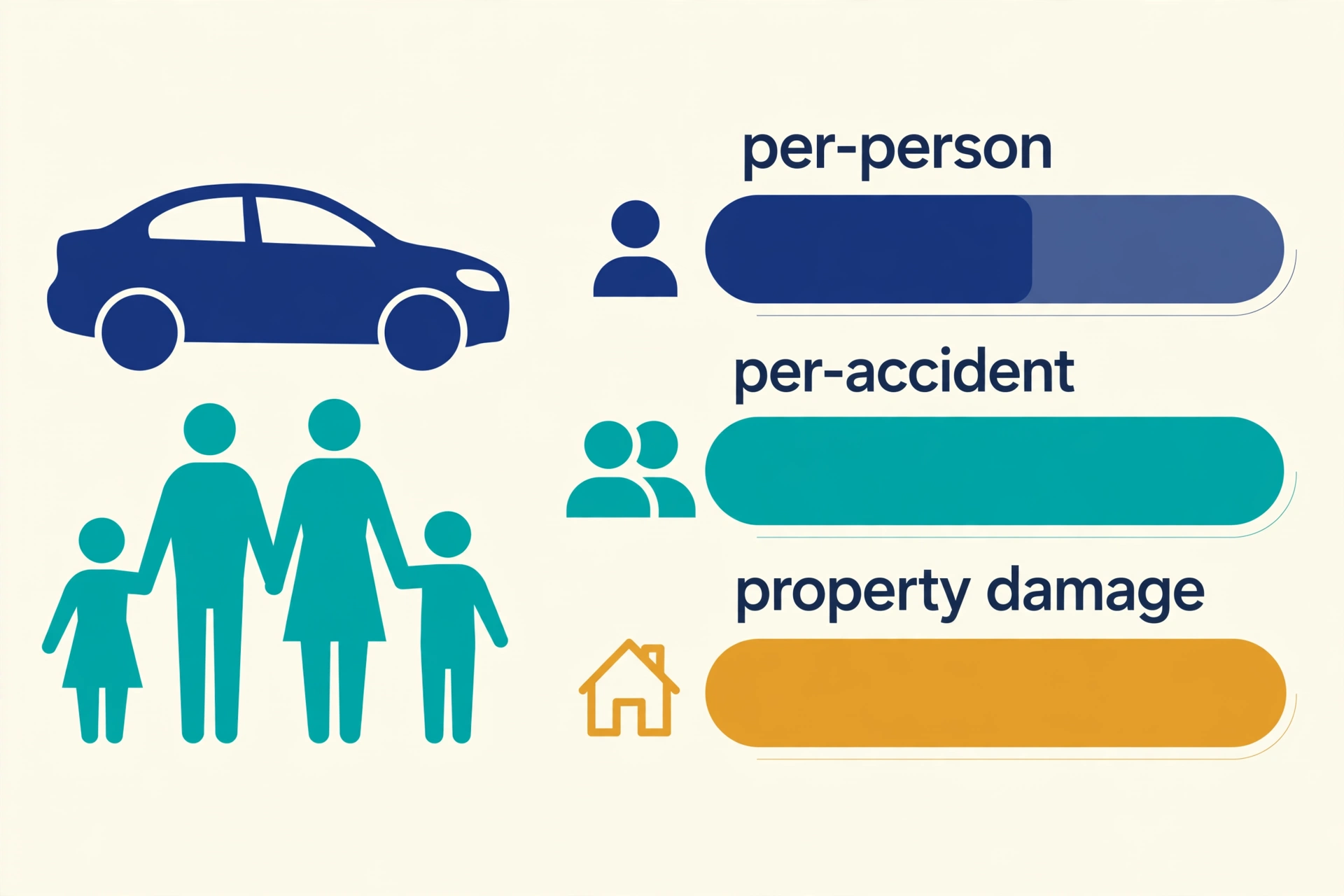
Liability coverage is written as three numbers, like 100/300/100. Here’s what each one does:
- First number ($100,000): the maximum paid for one person’s injuries in an accident you cause.
- Second number ($300,000): the maximum paid for all injuries combined in a single accident.
- Third number ($100,000): the maximum paid for property damage — other cars, fences, buildings.
Some insurers offer a combined single limit instead — for example, $300,000 total for injuries and property damage combined. Either format works; what matters is that the total protection matches your assets.
The 5 Coverage Types You Should Know

1. Liability (required in almost every state)
Pays for injuries and damage you cause to others. This is the core of your policy — and the coverage most worth increasing beyond the state minimum.
2. Collision
Pays to repair or replace your car after an accident, regardless of fault. Required if you have a car loan or lease.
3. Comprehensive
Covers non-crash damage: theft, vandalism, hail, falling branches, hitting a deer. Also usually required by lenders.
4. Uninsured/Underinsured Motorist (UM/UIM)
Protects you when the at-fault driver has no insurance or too little. About 1 in 7 US drivers is uninsured, so match this to your liability limits — don’t skip it.
5. Medical Payments / Personal Injury Protection (MedPay/PIP)
Covers medical bills for you and your passengers regardless of fault. Required in no-fault states; a smart add-on everywhere else.
How Much Coverage Do You Need? (By Situation)
The right amount depends on what you have to protect. A good rule: carry enough liability to cover your net worth (assets minus debts), so a lawsuit can’t take your home or savings.
| Your situation | Recommended liability | Extras |
|---|---|---|
| Student / renter, few assets | 50/100/50 minimum | Match UM/UIM to liability |
| Homeowner or $50K–$500K in assets | 100/300/100 | Full UM/UIM, $1,000 deductible |
| $500K+ in assets | 250/500/250 | Add a $1M umbrella policy |
| Financed or leased car | 100/300/100 | Collision + comprehensive (lender requires it) |
| Older car worth under $4,000 | 100/300/100 liability | Consider dropping collision/comprehensive |
State Minimums vs. What’s Actually Enough
Every state sets a legal minimum — commonly 25/50/25, though some states go as low as 15/30/5. These minimums were set decades ago and haven’t kept up with medical costs. The average full-coverage policy in the US now costs about $2,314 per year, while bare-minimum coverage averages around $842 (III/Quadrant 2025 data).
That ~$1,470 difference buys dramatically more protection. If you cause a $90,000 accident carrying 25/50/25, you’re personally on the hook for $65,000. With 100/300/100, you pay nothing beyond your premium.
Choosing Your Deductible
Your deductible is what you pay out of pocket before collision or comprehensive kicks in. Common choices: $500 or $1,000.
- $500 deductible: higher monthly premium, less shock at claim time.
- $1,000 deductible: lower premium — best if you have $1,000 in emergency savings.
Rule of thumb: pick the highest deductible you could pay tomorrow without stress. The premium savings on a $1,000 deductible typically pay for themselves within a year or two of claim-free driving.
5 Ways to Lower Your Premium Without Losing Protection
- Shop every 12 months. Loyalty rarely pays — insurers price new customers aggressively.
- Bundle home + auto. Multi-policy discounts often save 10–25%.
- Raise your deductible to $1,000 if you have the savings to cover it.
- Ask about every discount: good driver, good student, low mileage, defensive driving course, paperless billing.
- Improve your credit-based insurance score where your state allows it — it quietly affects most quotes.
Frequently Asked Questions
Is full coverage worth it on an old car?
If your car is worth less than about $4,000, compare the annual cost of collision + comprehensive against the car’s value. Often, dropping them and keeping strong liability is the smarter move.
Do I need uninsured motorist coverage?
Yes. Roughly 1 in 7 drivers has no insurance at all. UM/UIM is cheap and protects you from the worst-case scenario — being hit by someone who can’t pay.
What is an umbrella policy?
An extra $1 million (or more) of liability that kicks in after your auto and home limits are exhausted. It typically costs only $150–$350 per year and is the cheapest protection high-net-worth drivers can buy.
How often should I review my coverage?
Once a year, and after any major life change: paying off your car loan, buying a home, adding a teen driver, or a big change in commute or savings.
The Bottom Line
For most drivers, 100/300/100 liability + matching UM/UIM + comprehensive/collision with a $1,000 deductible is the sweet spot: strong protection at a reasonable price. Match your limits to your assets, review yearly, and never settle for state minimums if you have anything worth protecting.