
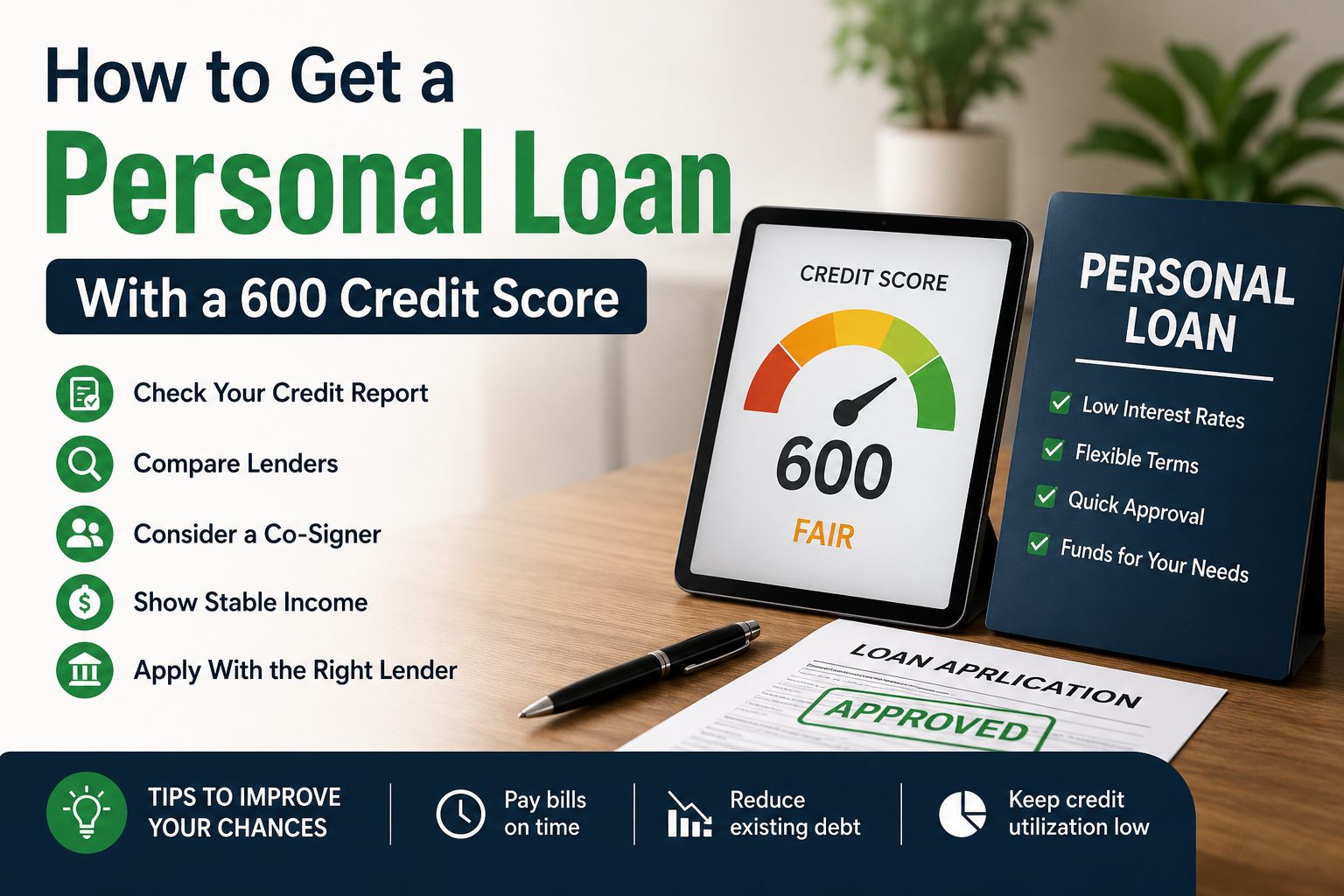
A 600 credit score can make borrowing money more difficult, but it does not automatically prevent you from getting a personal loan. Some lenders consider applicants with fair or below-average credit, although approval, interest rates, loan amounts, and repayment terms can vary significantly.
If your credit score is around 600, the goal should not simply be to find a lender that says “yes.” You should compare the APR, fees, monthly payment, total repayment cost, and lender requirements before accepting an offer.
This guide explains how personal loans work with a 600 credit score, what lenders may consider, how to improve your approval chances, and what alternatives may be worth considering.
Table of Contents
Can You Get a Personal Loan With a 600 Credit Score?
Yes, it is possible to qualify for a personal loan with a 600 credit score, but approval is not guaranteed.
Credit scores are only one part of a lender’s decision. Depending on the lender, other factors may include:
- Income
- Employment and income stability
- Existing debts
- Debt-to-income ratio
- Credit history
- Recent credit applications
- Loan amount requested
- Repayment term
- Whether the loan is secured or unsecured
Two people with the same credit score can receive very different loan offers because their overall financial profiles are different.
What Does a 600 Credit Score Mean?
A FICO score of 600 falls within the fair credit range. It is below the range generally considered good credit, which begins at 670 under the FICO scoring model.
A fair score can make borrowing more expensive because lenders may consider the applicant a higher credit risk.
However, your credit score is not permanent. Responsible borrowing, consistent on-time payments, and reducing revolving debt can help improve your credit profile over time.
What Do Lenders Look At Besides Your Credit Score?
1. Income
Lenders generally want to know that you have enough reliable income to make your monthly payments.
A higher income does not guarantee approval, but stable income can strengthen an application.
You may be asked to provide information such as:
- Employer information
- Pay stubs
- Bank statements
- Tax documents
- Other proof of income
Requirements vary by lender.
2. Debt-to-Income Ratio
Your debt-to-income ratio, or DTI, compares your monthly debt obligations with your gross monthly income.
For example, suppose your gross monthly income is $4,000 and your monthly debt payments total $1,200.
Your DTI would be:
$1,200 ÷ $4,000 × 100 = 30%
A lower DTI can make your application more attractive because it indicates that less of your income is already committed to debt payments.
Lenders use different DTI requirements, so there is no single percentage that guarantees approval.
3. Credit History
Lenders may examine more than your current score.
They can also consider:
- Late payments
- Defaults
- Collections
- Recent credit applications
- Length of credit history
- Existing accounts
- Credit utilization
A 600 score accompanied by recent missed payments may be viewed differently from a 600 score resulting from an older credit problem.
4. Loan Amount
The amount you request can affect the lender’s assessment of risk.
If you have fair credit, requesting a smaller amount that you can comfortably repay may be more realistic than applying for a very large loan.
Only borrow what you actually need and can afford to repay.
How to Get a Personal Loan With a 600 Credit Score
Step 1: Check Your Credit Reports
Before applying, review your credit reports for inaccurate information.
Look for:
- Accounts you don’t recognize
- Incorrect balances
- Incorrect payment history
- Duplicate accounts
- Outdated information
If you find an error, dispute it with the appropriate credit reporting company.
Checking your own credit report is different from submitting a loan application and does not itself mean you have applied for a new loan.
Step 2: Calculate Your Budget
Before comparing lenders, determine how much you can realistically afford each month.
For example, don’t choose a $10,000 loan simply because a lender offers it.
Start with:
How much do I actually need?
Then ask:
What monthly payment can I comfortably afford?
Remember that a longer repayment term can reduce the monthly payment while increasing the total interest paid.
Step 3: Compare Multiple Lenders
Don’t accept the first offer you receive.
Compare:
- APR
- Interest rate
- Origination fees
- Late fees
- Loan amount
- Repayment period
- Monthly payment
- Prepayment policies
- Total cost of the loan
Some lenders allow borrowers to check potential rates through prequalification without immediately submitting a full application. However, the exact process and whether a credit inquiry occurs depends on the lender.
Step 4: Consider a Co-Signer Carefully
A qualified co-signer may strengthen an application in some lending situations.
A co-signer agrees to take responsibility for the debt if the primary borrower does not repay it.
That means co-signing is a serious financial commitment.
Before asking someone to co-sign, make sure both parties understand the loan terms and potential consequences.
Step 5: Consider a Secured Loan
Some borrowers may have access to secured borrowing options.
A secured loan is backed by collateral. Because the lender has an asset securing the debt, the risk can differ from an unsecured personal loan.
However, there is an important trade-off:
If you fail to repay a secured loan according to its terms, you may risk losing the collateral.
Never pledge an important asset without fully understanding the consequences.
What Personal Loan Interest Rate Can You Get With a 600 Credit Score?
There is no single interest rate specifically assigned to a 600 credit score.
Your rate can depend on:
- Credit profile
- Income
- Existing debt
- Loan amount
- Loan term
- Lender
- Economic conditions
- Whether the loan is secured or unsecured
This is why comparing APRs is more useful than relying on a generic “600 credit score loan rate.”
Why APR Matters
APR can provide a broader view of borrowing costs because it can incorporate the interest rate and certain loan fees.
For example, two loans could have similar advertised interest rates but different fees, resulting in different APRs and total costs.
Always read the lender’s disclosures before accepting an offer.
How Much Can You Borrow With a 600 Credit Score?
There is no universal loan amount available to everyone with a 600 credit score.
One lender might offer a relatively small loan while another could consider a larger amount.
The amount can depend on:
- Income
- DTI
- Credit history
- Loan purpose
- Lender policies
- Existing obligations
- Ability to repay
Instead of asking only, “How much can I borrow?”, ask:
“How much can I repay without damaging my finances?”
That is a much more useful question.
Ways to Improve Your Chances of Approval
If you’re not in a hurry, improving your financial profile before applying may help.
Pay Bills on Time
Payment history is an important part of many credit scoring models.
Set up reminders or automatic payments where appropriate so you don’t accidentally miss due dates.
Reduce Credit Card Balances
High credit utilization can negatively affect credit scores.
Paying down revolving balances can potentially improve your credit profile, although the effect varies from person to person.
Avoid Unnecessary Applications
Submitting multiple full loan applications within a short period can create additional hard inquiries depending on how lenders process applications.
Instead, research lenders first and use prequalification options when available.
Increase Your Income When Possible
A stable and sufficient income can strengthen your overall application.
If you have additional legitimate income sources, check whether the lender allows them to be included and what documentation is required.
Correct Credit Report Errors
If inaccurate information is lowering your credit profile, dispute the information with the relevant credit reporting company.
Personal Loan Alternatives for a 600 Credit Score
A personal loan isn’t always the best solution.
Depending on your circumstances, alternatives may include:
Credit Union Loans
Some credit unions offer personal lending products and may consider factors beyond a credit score.
Membership requirements and loan terms vary.
Secured Credit Products
A secured product may be an option for some borrowers, but always understand the collateral requirements and costs.
Credit Counseling
If you’re struggling with existing debt, a reputable nonprofit credit counseling organization may help you understand your options.
Building an Emergency Fund
If the expense isn’t urgent, delaying the loan and building savings may reduce the need to borrow.
Red Flags to Watch for When Comparing Loans
Be careful with lenders or websites that:
- Guarantee approval regardless of credit history
- Demand large upfront fees before providing a loan
- Ask you to send money through unusual payment methods
- Pressure you to make an immediate decision
- Hide the APR or major fees
- Request unnecessary sensitive information
- Make promises that sound too good to be true
Before accepting a loan, verify that you’re dealing with a legitimate lender and carefully review the official loan agreement.
Never assume that a website is trustworthy simply because it appears professional.
Example: Comparing Two Personal Loan Offers
Imagine you are considering a $5,000 personal loan.
Offer A
- Lower APR
- $100 origination fee
- 36-month term
Offer B
- Higher APR
- No origination fee
- 36-month term
The advertised interest rate alone doesn’t tell you which loan is cheaper.
You should compare:
APR + fees + monthly payment + total repayment
The best offer is not necessarily the one with the lowest advertised rate or the lowest monthly payment.
Should You Get a Personal Loan With a 600 Credit Score?
A personal loan may make sense if you have a legitimate need, understand the cost, and can comfortably make every payment.
It may not be a good idea if you’re borrowing simply to cover recurring expenses that you cannot otherwise afford.
Before accepting an offer, ask yourself:
- Do I really need the loan?
- Can I afford the monthly payment?
- Have I compared multiple offers?
- Do I understand the APR and fees?
- How much will I repay in total?
- Is there a less expensive alternative?
If you cannot comfortably answer these questions, consider slowing down before borrowing.
Frequently Asked Questions
Is a 600 credit score good enough for a personal loan?
A 600 score does not automatically disqualify you from a personal loan. However, lenders use their own eligibility criteria, and applicants with fair credit may receive fewer options or higher borrowing costs.
Can I get a $10,000 personal loan with a 600 credit score?
Possibly, but there is no universal rule. The lender may consider your income, DTI, credit history, requested term, and ability to repay.
Can I get a personal loan without collateral?
Yes. Many personal loans are unsecured, meaning they don’t require collateral. However, eligibility and pricing depend on the lender and your financial profile.
Will applying for a personal loan hurt my credit?
A full application can result in a hard credit inquiry, which may affect your credit score. Some lenders offer prequalification that uses a soft inquiry, but you should confirm the lender’s process before proceeding.
How can I improve my chances of getting approved?
Review your credit reports, reduce existing debt where possible, maintain on-time payments, compare multiple lenders, and apply for an amount that fits your budget.
Final Thoughts
Getting a personal loan with a 600 credit score can be possible, but approval should not be your only consideration.
The most important things to compare are APR, fees, monthly payment, repayment period, and total borrowing cost. If you don’t need the money immediately, improving your credit profile before applying may also give you more options.
Most importantly, don’t borrow more than you can realistically repay.
Notomy provides general financial education and does not provide personalized financial advice. Loan availability, rates, fees, and eligibility requirements vary by lender and applicant. Always review the lender’s current terms and disclosures before applying.


