


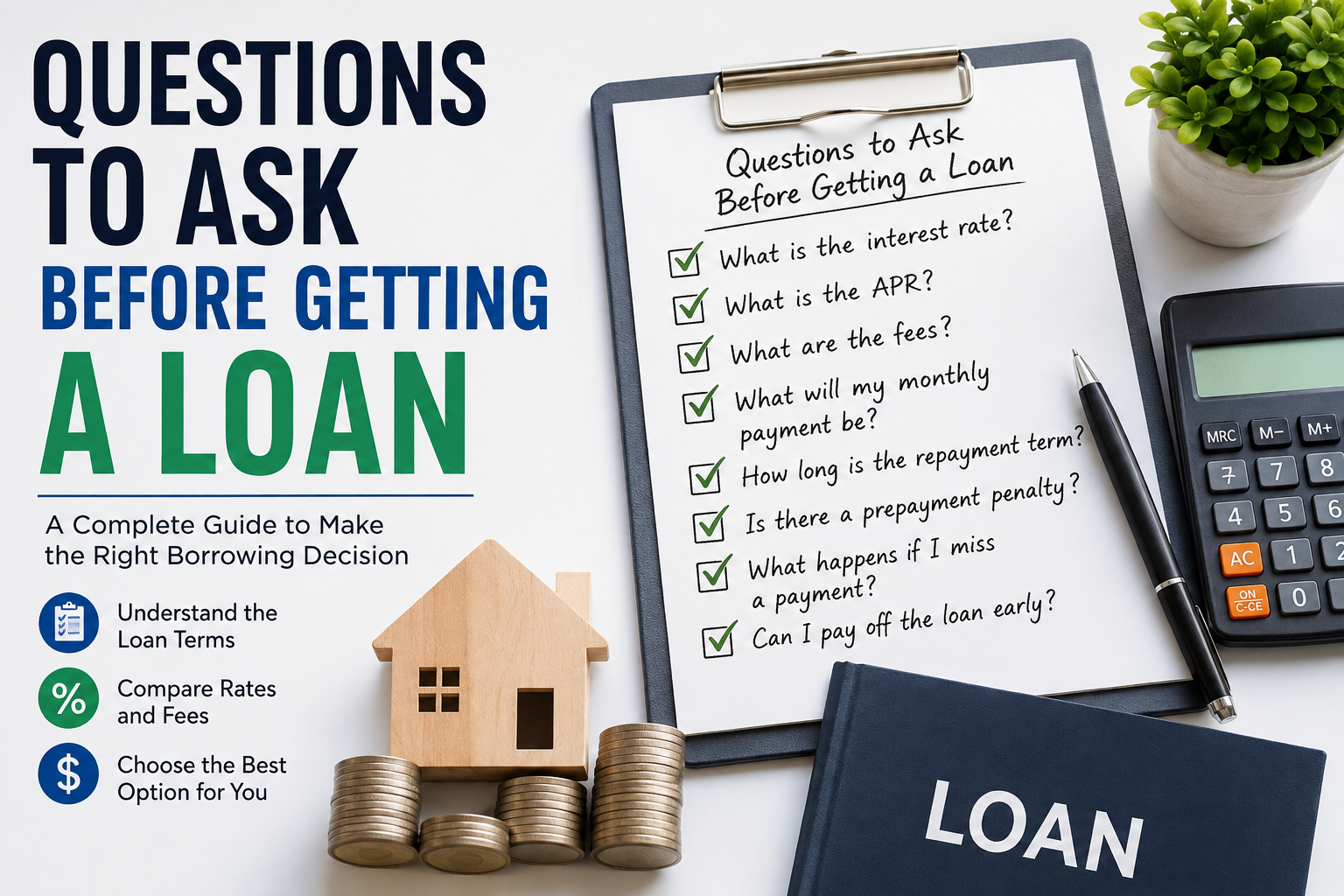
Getting a loan can help you pay for a major expense, consolidate debt, cover an emergency, or finance an important purchase. However, borrowing money is a financial commitment, and choosing the wrong loan can cost you significantly more than expected. Questions to Ask Before Getting a Loan: A Complete Guide
Before signing a loan agreement, it is important to understand the interest rate, fees, repayment schedule, total cost, and potential risks. Asking the right questions can help you compare lenders and choose a loan that fits your financial situation.
In this guide, we cover the most important questions to ask before getting a loan.
Table of Contents
1. What Type of Loan Do I Need?
The first question to ask is whether the loan is appropriate for your situation.
Different loans are designed for different purposes. Common types include:
- Personal loans
- Auto loans
- Mortgage loans
- Student loans
- Debt consolidation loans
- Business loans
- Emergency loans
A personal loan, for example, may be useful for consolidating credit card debt or paying for a large expense, while an auto loan is specifically designed for purchasing a vehicle.
Understanding your purpose can help you avoid borrowing more than you actually need.
2. What Is the Interest Rate?
The interest rate is one of the most important factors to consider when comparing loans.
Ask the lender:
“What interest rate will I receive, and is it fixed or variable?”
A fixed interest rate generally stays the same throughout the loan term. A variable rate can change over time depending on the terms of the loan.
Don’t automatically choose the lender advertising the lowest rate. Make sure you understand whether the advertised rate is available to you and what conditions apply.
3. What Is the APR?
The annual percentage rate, commonly called APR, can give you a better idea of the overall borrowing cost.
Ask:
“What is the APR, including applicable fees?”
The APR may include certain fees in addition to the interest rate, making it useful when comparing different loan offers.
For example, one lender may advertise a lower interest rate but charge higher fees. Another lender may have a slightly higher interest rate but fewer fees.
Comparing APRs can help you make a more informed decision.
4. How Much Will My Monthly Payment Be?
Before accepting a loan, find out exactly how much you will have to pay each month.
Ask:
“What will my total monthly payment be?”
Make sure the payment fits comfortably within your budget.
A loan with a lower monthly payment isn’t necessarily cheaper. Sometimes a longer repayment period lowers the monthly payment but increases the total amount of interest you pay.
5. How Much Will I Pay in Total?
This is one of the most important questions borrowers often overlook.
Ask the lender:
“How much money will I repay over the entire life of the loan?”
For example, borrowing $10,000 does not mean you will repay exactly $10,000. Interest and fees can increase the total cost considerably.
Always compare the amount borrowed with the total amount you are expected to repay.
6. What Fees Does the Loan Have?
Loans can come with different fees.
Before signing, ask whether the loan includes:
- Origination fees
- Application fees
- Late-payment fees
- Prepayment penalties
- Annual fees
- Returned-payment fees
- Other administrative charges
Ask the lender to provide all applicable fees in writing.
Even relatively small fees can add up over time.
7. Is There a Prepayment Penalty?
If you expect to pay your loan off early, ask:
“Will I be charged a penalty for paying the loan early?”
Some loans may have prepayment penalties or other restrictions, while others allow borrowers to make additional payments without a penalty.
Understanding this before borrowing can give you more flexibility later.
8. How Long Is the Repayment Term?
The loan term determines how long you will make payments.
Common terms vary depending on the type and amount of the loan.
Ask:
“How many months or years will I have to repay this loan?”
A longer term can make monthly payments more manageable, but you may pay more interest over the life of the loan.
A shorter term may result in higher monthly payments but could reduce the overall interest cost.
9. What Credit Score Do I Need?
Your credit history can influence whether you qualify and what interest rate you receive.
Ask:
“What credit requirements do you have?”
Lenders may consider factors such as:
- Credit history
- Credit score
- Income
- Existing debt
- Employment
- Debt-to-income ratio
Don’t assume that you need perfect credit to qualify for every loan. Different lenders have different requirements.
10. Will Applying Affect My Credit?
Ask the lender:
“Will this application involve a hard credit inquiry?”
Some lenders may offer prequalification using a soft credit inquiry, which generally does not affect your credit score in the same way as a hard inquiry.
However, a formal loan application may involve a hard inquiry.
Understanding the process before applying can help you manage your credit applications more carefully.
11. Can I Borrow Less?
Just because a lender offers you a certain amount doesn’t mean you should borrow the maximum.
Ask:
“Can I choose a smaller loan amount?”
Borrowing only what you need can reduce your monthly payment and potentially lower the total interest you pay.
Before applying, calculate how much money you actually need.
12. How Quickly Will I Receive the Money?
If you need money for an urgent expense, timing may be important.
Ask:
“How long does it take to receive the funds after approval?”
The timeline can vary depending on the lender, loan type, verification process, and other factors.
Don’t choose a loan solely because it promises fast funding. Consider the complete cost and terms as well.
13. What Happens If I Miss a Payment?
Unexpected financial problems can happen.
Ask:
“What happens if I cannot make a payment on time?”
Find out about:
- Late fees
- Grace periods
- Reporting to credit bureaus
- Payment assistance
- Hardship programs
- Potential collection activity
Knowing the consequences beforehand can help you plan for unexpected situations.
14. Can I Change My Payment Date?
Some lenders may provide flexibility regarding payment dates.
If your income arrives on a particular day of the month, ask whether you can choose a payment date that works with your budget.
A payment schedule that matches your cash flow can make it easier to avoid missed payments.
15. Is the Loan Secured or Unsecured?
Ask:
“Do I need to provide collateral?”
A secured loan is backed by an asset, such as a vehicle or property. An unsecured loan generally does not require collateral.
Understanding whether your property is at risk is essential before accepting a loan.
16. Are There Any Restrictions on How I Use the Money?
Some loans can be used for a wide variety of personal expenses, while others have specific purposes.
Ask:
“Are there restrictions on how I can use the loan funds?”
This is particularly important if you’re considering using a loan for debt consolidation, education, home improvements, business expenses, or another specific purpose.
17. Should I Compare Multiple Lenders?
Yes. Comparing multiple loan offers can help you understand the range of rates, fees, terms, and monthly payments available to you.
Instead of accepting the first offer you receive, compare:
- APR
- Interest rate
- Monthly payment
- Loan term
- Total repayment amount
- Fees
- Prepayment rules
- Eligibility requirements
The cheapest-looking monthly payment isn’t necessarily the cheapest loan overall.
Questions to Ask Before Getting a Personal Loan
If you’re considering a personal loan, here is a quick checklist:
- What is the APR?
- Is the interest rate fixed?
- What will my monthly payment be?
- How much will I repay in total?
- Are there origination fees?
- Are there late fees?
- Is there a prepayment penalty?
- What credit score is required?
- Will you perform a hard credit inquiry?
- How long is the repayment term?
- How quickly will I receive the funds?
- Can I make additional payments?
- Are there restrictions on using the funds?
- What happens if I miss a payment?
- Can I change my payment date?
Questions to Ask About a Debt Consolidation Loan
If you’re considering a loan to consolidate existing debt, ask additional questions.
Will the new loan actually reduce my overall borrowing cost?
A lower monthly payment doesn’t automatically mean you’ll save money. A longer repayment term can result in more interest being paid over time.
Also ask:
- What debts can be consolidated?
- What is the new APR?
- What fees will I pay?
- What will my new monthly payment be?
- How long will repayment take?
- What is the total amount I will repay?
- Can I pay the loan off early?
- Does the lender pay creditors directly?
- Will I still have access to my old credit accounts?
Questions to Ask Yourself Before Taking a Loan
It’s also important to ask yourself a few questions.
Do I really need to borrow this money?
Consider whether the expense is essential or whether you can save for it instead.
Can I comfortably afford the payment?
Look at your monthly income and essential expenses before adding another financial obligation.
Have I compared different offers?
Don’t assume the first lender is the best option.
What happens if my income decreases?
Think about whether you could continue making payments if you faced an unexpected financial setback.
Am I borrowing to solve a temporary problem?
If you’re repeatedly borrowing money to pay regular expenses, a loan may not address the underlying financial issue.
Final Thoughts
Knowing what questions to ask before getting a loan can help you make a more informed financial decision. Don’t focus only on the advertised interest rate or monthly payment. Look at the APR, fees, repayment term, total repayment amount, and other loan conditions.
Before accepting an offer, compare multiple options and make sure the payment fits your budget.
Remember: A loan is a financial commitment. Take time to understand the terms and consider whether borrowing is appropriate for your situation.
Frequently Asked Questions
What is the most important question to ask before getting a loan?
Ask how much the loan will cost you in total, including interest and applicable fees. This helps you understand the true cost of borrowing.
Is APR more important than the interest rate?
APR can be useful for comparing loan offers because it may reflect certain fees in addition to the interest rate. However, always review the lender’s complete terms.
Should I accept the first loan offer I receive?
Not necessarily. Comparing multiple offers can help you find terms that better fit your financial needs.
Does a longer loan term lower my monthly payment?
A longer repayment term can reduce the required monthly payment, but it may also increase the total amount of interest paid.
Can I pay off a loan early?
It depends on the lender and loan agreement. Check whether the loan has any prepayment penalties before signing.
What should I check before signing a loan agreement?
Review the APR, interest rate, monthly payment, repayment term, fees, total repayment amount, late-payment rules, and prepayment conditions.




