
Everything you need to know about insurance — from timeless principles to the transformative forces reshaping the industry in 2026.
By Editorial TeamMay 8, 202615-minute read
Insurance is one of the oldest and most essential financial tools in human history — a contract of trust that turns uncertainty into manageable risk. Whether protecting your home, your health, your business, or your life, insurance stands as the quiet safety net beneath every major decision we make.
Table of Contents
Section 01 What Is Insurance?
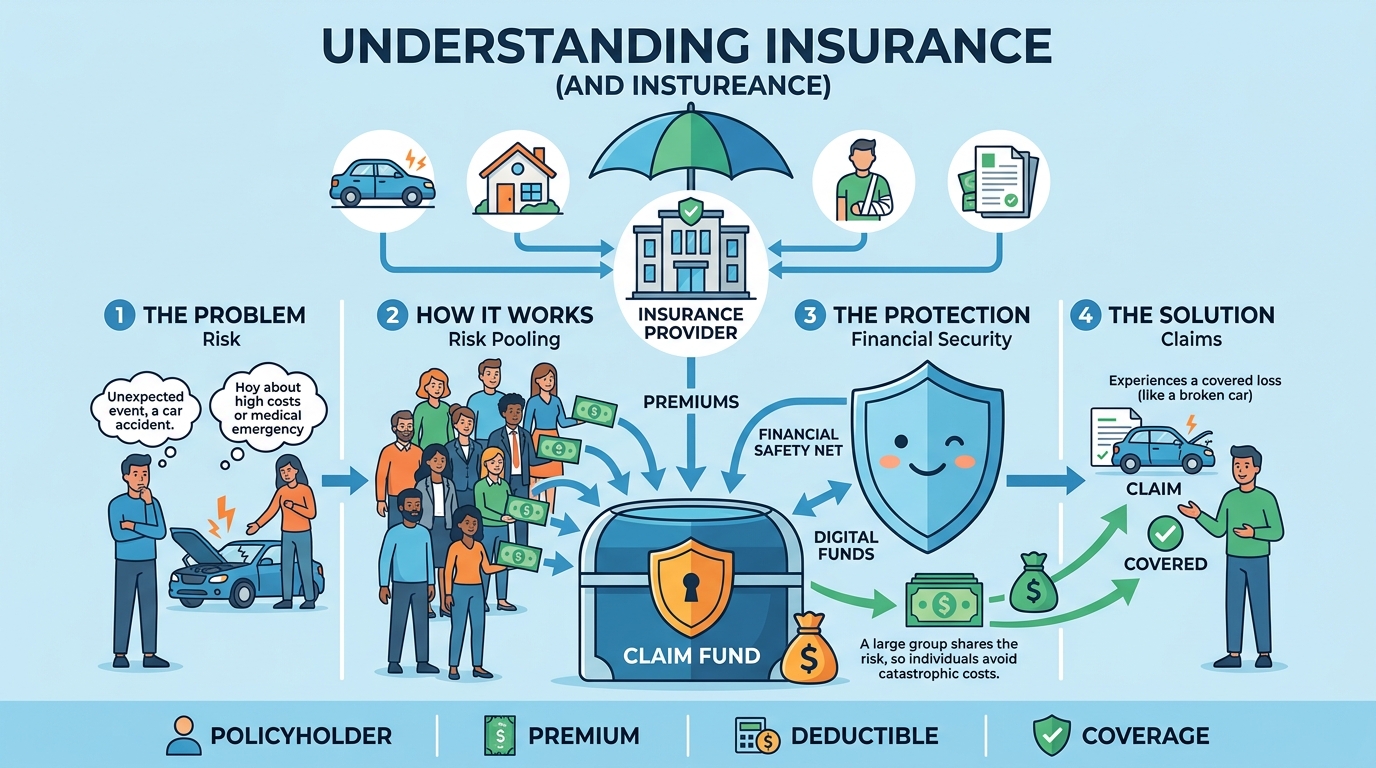
At its most fundamental, insurance is a financial arrangement in which an individual or organization pays a premium to an insurer in exchange for protection against potential future losses. The insurer pools these premiums from many policyholders, so when one of them suffers a loss, the collective fund covers the cost.
The word “insurance” traces its roots to the Latin securus — meaning “free from care.” That spirit remains unchanged centuries later. Insurance converts the unpredictable into the predictable, turning catastrophic possibilities into manageable, known costs.
“Insurance is the only product in the world where the seller hopes you never use it — and the buyer hopes the same.”— Common industry wisdom
The basic mechanics are simple: a large group of people each pay a small, regular premium. Most of them will never make a large claim. But a few will face serious losses — a house fire, a medical emergency, a car accident — and the pooled fund covers those losses. Everyone benefits from the certainty, even those who never file a claim.
$975B+
U.S. P&C market size (2026)
$100B+
Annual global catastrophe losses
160M+
Uninsured Americans (health gaps)
68%
Under-40s calling life insurance essential
Section 02 Types of Insurance
Insurance products cover virtually every aspect of life and commerce. Here are the major categories every individual and business should understand:
Life Insurance
Comes in two primary forms — term (pure protection for a set period) and whole/universal life (lifelong coverage with a savings component).
Health Insurance
Covers medical expenses including doctor visits, hospitalization, surgery, and prescriptions. Employer-sponsored, government (Medicare/Medicaid), or individually purchased plans are the main routes.
Auto Insurance
Protects against financial loss in vehicle accidents. Typically includes liability, collision, and comprehensive coverage. Mandatory in most countries and jurisdictions.
Home & Property
Covers damage to your home and personal belongings from fire, theft, storms, and other perils. Mortgage lenders typically require this coverage for financed properties.
Business / Commercial
Protects businesses from operational, legal, and financial risks. Includes general liability, professional indemnity, commercial property, workers’ compensation, and more.
Cyber Insurance
One of the fastest-growing lines, covering data breaches, ransomware attacks, business interruption from cyber incidents, and regulatory fines. Now a core product for businesses of all sizes.
Section 03 How Insurance Works: The Key Concepts
Understanding a few key terms helps you make smarter insurance decisions.
Premium — The amount you pay (monthly, quarterly, or annually) to keep your policy active. Premiums are calculated based on the probability and cost of potential claims.
Deductible (Excess) — The amount you must pay out-of-pocket before your insurer begins covering costs. A higher deductible generally means a lower premium, and vice versa.
Coverage Limit — Choosing the right limit is critical — being underinsured can leave you with significant uncovered costs.
Underwriting — The process by which an insurer evaluates the risk of insuring a person or entity and determines the appropriate premium. AI and machine learning are rapidly transforming this process.
Claim — A formal request to your insurer for payment following a covered loss. The claims process is where the promise of insurance is fulfilled — or fails.
Insurance is not merely a financial product — it is the economic infrastructure that allows individuals to take risks, start businesses, own homes, and live without paralysing fear of what tomorrow might bring.
Section 04 The State of Insurance in 2026: Key Trends
The insurance industry is undergoing its most significant transformation in generations. Five forces are reshaping how coverage is designed, sold, priced, and delivered:
01
Artificial Intelligence Becomes the Operating System
Machine learning models now analyse loss history, satellite imagery, telematics data, and social signals to identify risk patterns and adjust pricing in real time. Automated underwriting delivers instant quotes with dynamic risk assessment, while AI-powered claims processing is accelerating settlements by up to 40%. Fraud detection has become dramatically more precise, saving the industry billions annually.
02
Climate Risk Becomes a Crisis
Natural catastrophes now consistently cause over $100 billion in insured losses globally each year. California’s wildfires alone caused an estimated $40 billion in losses in 2025, while severe convective storms across the U.S. added another $50 billion. Insurers are being forced to exit certain high-risk markets, raise premiums sharply in flood and wildfire zones, and fundamentally rethink their catastrophe underwriting models.
03
Cyber Insurance Becomes Essential
The cyber threat landscape is expanding rapidly, with companies of all sizes facing ransomware, data breaches, and emerging threats like deepfake-enabled fraud and supply-chain cyber incidents. Cyber insurance has evolved from a niche product into a fast-growing, core segment of the market. Demand is being driven not just by the frequency of attacks, but by regulatory requirements that now mandate coverage in many industries.
04
Personalisation and Data-Driven Policies
With 60% of customers now willing to share personal data in exchange for tailored coverage, insurers are shifting from static, one-size-fits-all products to dynamic, behaviour-linked policies. Telematics-based auto insurance rewards safe drivers. Wearable devices inform health premium pricing. Lifestyle-linked life insurance adapts over time. The era of truly personalised insurance has arrived.
05
Parametric Insurance Goes Mainstream
Parametric insurance — which pays out automatically when a defined trigger event occurs (such as rainfall exceeding a threshold or wind speeds surpassing a limit) rather than requiring a traditional claims process — is rapidly gaining ground. The market is projected to reach $51.3 billion by 2034, driven by climate-related disasters and AI adoption. These products deliver rapid liquidity where traditional indemnity policies can be slow.
Section 05 How to Choose the Right Insurance
Selecting the right insurance requires balancing cost, coverage, and risk tolerance. There is no single perfect policy — only the right policy for your circumstances.
Seven principles for smarter insurance decisions
- Assess your actual risks first. What would financially devastate you if it happened? Those are the risks to insure against — not the small, manageable ones.
- Don’t insure what you can afford to lose. High deductibles reduce premiums significantly — consider keeping more risk yourself for smaller losses.
- Compare multiple quotes, not just prices. The cheapest policy is worthless if it doesn’t pay out when you need it. Scrutinise exclusions carefully.
- Understand the claims process before you buy. A good insurer’s true test is how they handle claims — read reviews from claimants, not just new customers.
- Review your coverage annually. Your risk profile changes. Marriage, children, a new home, a business — all of these create new coverage needs.
- Bundle strategically. Many insurers offer meaningful discounts for holding multiple policies (home + auto, for example), but ensure the coverage quality doesn’t drop.
- Check the insurer’s financial strength. Only buy from insurers with strong credit ratings (A or above from AM Best, S&P, or Moody’s). Your premium is only as good as the company’s ability to pay claims.

Section 06 The Future of Insurance
Looking beyond 2026, several forces will continue to reshape the industry. The combination of AI maturation, the Internet of Things, and seamless digital ecosystems is redefining insurance from reactive coverage to proactive, hyper-personalised protection.
Insurers are increasingly shifting from “repair and replace” models toward prevention. Smart home sensors detect water leaks before they become floods. Connected vehicles monitor driving behaviour in real time. Health insurers track wellness metrics and reward healthy habits. The boundary between insurer and wellness partner is blurring.
Life insurance faces particular pressure to modernise. who expect flexible, digital-first experiences. Insurers that respond with mobile-first design, personalised guidance, and lifestyle-linked products stand to capture significant market share.
Meanwhile, the talent pipeline is a growing concern. The insurance workforce is ageing, with the population of professionals aged 55 and older growing by 74% over the last decade. Industry analysts project more than 400,000 open positions in the coming years as experienced professionals retire — creating both a challenge and an opportunity for the next generation of talent to enter and shape the industry.
The insurance industry of 2030 will look radically different from today’s — not because the fundamental purpose of insurance will change, but because every aspect of how it is delivered, priced, and experienced will be transformed.
Final Thought
Insurance is not a grudge purchase — it is an act of wisdom. It is the acknowledgement that life is uncertain, and that responsible individuals and organisations plan for that uncertainty. As the world grows more complex, more connected, and more exposed to new and unpredictable risks, the role of insurance in society will only grow more important. Understanding it is no longer optional — it is essential.t


