
Managing your money doesn’t have to be complicated. A monthly budget helps you understand where your income goes, control unnecessary spending, and work toward financial goals with confidence. Whether you’re saving for a home, paying off debt, or simply trying to avoid running out of money before payday, a budget gives you a clear plan. How to Create a Monthly Budget
This guide explains how to create a monthly budget from scratch, the budgeting methods you can use, common mistakes to avoid, and practical tips that make sticking to a budget easier.
Table of Contents
What Is a Monthly Budget?
A monthly budget is a financial plan that estimates your income and organizes how you’ll spend or save it during a month. Instead of wondering where your money went, a budget helps you decide where it should go before you spend it.
A good budget isn’t about cutting out everything you enjoy. It’s about making intentional choices so your spending aligns with your priorities.
Why Is a Monthly Budget Important?
Creating a monthly budget offers several benefits:
- Helps you control spending
- Reduces financial stress
- Makes saving easier
- Helps pay off debt faster
- Prevents unnecessary purchases
- Improves long-term financial planning
- Builds healthy money habits
Even a simple budget can make a noticeable difference over time.
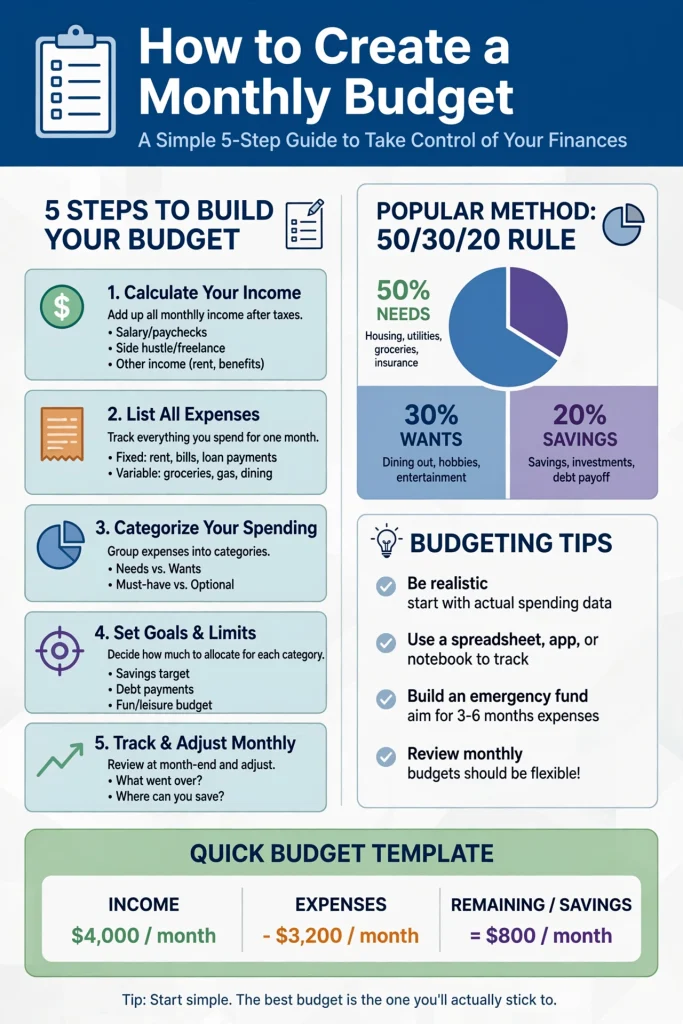
Step 1: Calculate Your Monthly Income
The first step is to determine how much money you receive each month.
Include all reliable income sources, such as:
- Salary or wages
- Freelance income
- Business income
- Rental income
- Pension or retirement income
- Government benefits (if applicable)
- Investment income
If your income changes every month, use the average of the last six to twelve months as your starting estimate.
Step 2: List All Your Monthly Expenses
Write down everything you spend money on.
Fixed Expenses
These usually remain similar each month.
Examples include:
- Rent or mortgage
- Insurance
- Internet
- Phone bill
- Loan payments
- Subscription services
Variable Expenses
These change from month to month.
Examples include:
- Groceries
- Fuel
- Entertainment
- Dining out
- Shopping
- Medical expenses
Review your recent bank statements or expense history to make your budget more accurate.
Step 3: Categorize Your Spending
Group your expenses into categories.
For example:
Housing
- Rent
- Utilities
- Home maintenance
Transportation
- Fuel
- Public transport
- Vehicle maintenance
Food
- Groceries
- Restaurants
- Coffee shops
Savings
- Emergency fund
- Retirement savings
- Investment contributions
Debt
- Credit card payments
- Personal loans
- Student loans
Clear categories make it easier to identify areas where you can reduce spending.
Step 4: Choose a Budgeting Method
Different budgeting methods work for different people.
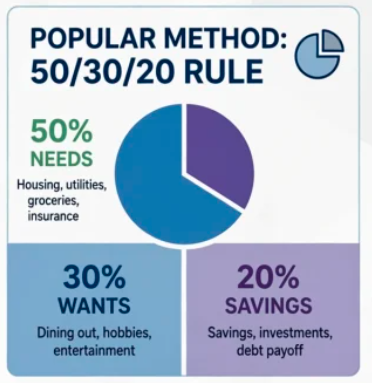
The 50/30/20 Rule
A common approach is to divide your after-tax income into three parts:
- 50% for essential needs
- 30% for wants
- 20% for savings and debt repayment
This method is easy to follow and works well for many households.
Zero-Based Budgeting
With zero-based budgeting, every dollar of your income is assigned a purpose until your income minus expenses equals zero.
This doesn’t mean spending everything—it means planning where every dollar goes, including savings.
Envelope Budgeting
Set spending limits for different categories. Traditionally this used cash envelopes, but many budgeting apps now offer virtual versions of the same idea.
Step 5: Set Realistic Spending Limits
Avoid creating a budget that’s impossible to follow.
If you normally spend $400 each month on groceries, don’t suddenly reduce it to $150 unless you have a practical plan for doing so.
Small, sustainable improvements usually work better than drastic cuts.
Step 6: Build an Emergency Fund
Unexpected expenses can quickly disrupt a budget.
Consider setting aside money every month for emergencies such as:
- Medical bills
- Car repairs
- Home repairs
- Temporary income loss
Even small, consistent contributions can help build financial resilience over time.
Step 7: Track Your Spending
Creating a budget is only the beginning.
Track your spending throughout the month to compare your actual expenses with your planned budget.
You can use:
- A spreadsheet
- A notebook
- Budgeting apps
- Online banking tools
Regular tracking helps you notice patterns and make adjustments.
Free Monthly Budget Calculator 2026
Track your income and expenses in 60 seconds. Know how much you can save every month.
Monthly Budget Planner
Your financial situation changes over time.
Review your budget monthly to account for:
- Salary changes
- New bills
- Inflation
- Family expenses
- Financial goals
Treat your budget as a flexible plan rather than a fixed document.
Common Budgeting Mistakes
Many beginners make similar mistakes, including:
- Forgetting annual or irregular expenses
- Underestimating grocery costs
- Ignoring small daily purchases
- Not saving for emergencies
- Giving up after one difficult month
- Failing to review the budget regularly
Learning from these mistakes helps improve your budgeting skills over time.
Tips to Stick to Your Budget
- Plan meals before grocery shopping.
- Avoid impulse purchases by waiting before buying non-essential items.
- Compare prices before making major purchases.
- Cancel subscriptions you no longer use.
- Automate savings if possible.
- Set realistic financial goals.
Small habits often have a greater long-term impact than dramatic changes.
Best Budgeting Tools
Many people find budgeting easier with digital tools.
Popular options include:
- Google Sheets
- Microsoft Excel
- Budgeting mobile apps
- Online banking expense trackers
- Personal finance software
Choose a tool that matches your preferences and is easy to update consistently.
Frequently Asked Questions
How much should I save every month?
The amount depends on your income, expenses, and goals. Many people aim to save
Lorem ipsum dolor sit amet consectetur. Ut enim mauris at vel mi mauris sagittis. Arcu fames lectus habitasse feugiat suspendisse. Ipsum volutpat ornare placerat sit quis semper dui pharetra. Vestibulum a ipsum aenean nisi dictum tempor. Lacinia pharetra donec aliquam egestas lectus ut turpis. Sapien quam urna in quis vivamus pretium ultrices ac hac. Elementum sit nisl elit tincidunt tortor. Adipiscing aenean mattis sit enim nibh imperdiet


